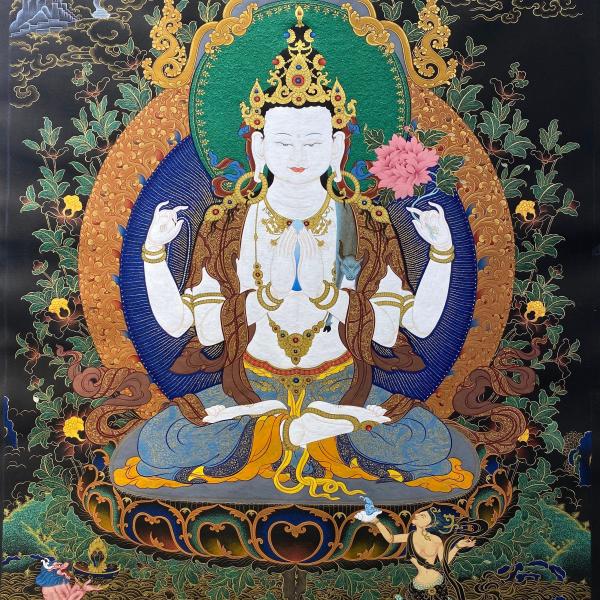
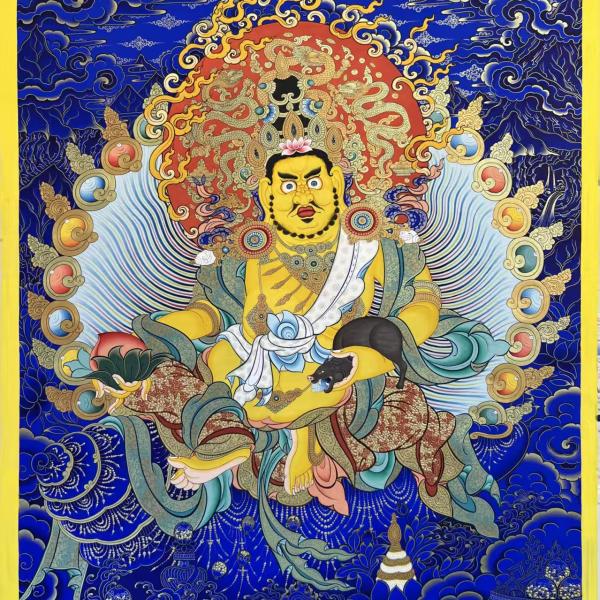
From Ore to Canvas: A Dialogue Across Millennia
A Regong Thangka painted centuries ago remains as vibrant as if created yesterday. The secret lies in mineral crystals sourced from deep within the earth.
All pigments used in Regong Thangka come from nature. Cinnabar from cinnabar ore delivers a solemn red; lapis lazuli grinds into deep ultramarine blue; malachite contributes emerald green. These pigments are precious not only because they come from gem-grade ores, but because each crystal has undergone hundreds of millions of years of geological evolution.
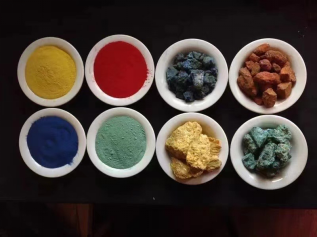
The secret of "millennial fade-resistance" lies in chemical stability. Mineral pigments are natural crystals with extremely high chemical inertness, resisting reactions with oxygen and moisture. Take cinnabar — its mercury-sulfur bond energy is so high that it barely reacts with any common substance at room temperature. In contrast, synthetic pigments have fragile molecular structures that gradually decompose under UV, oxygen, and humidity — which is why ordinary posters fade within years. Mineral pigments, however, are essentially rock. Rock survives for hundreds of millions of years in nature. Ground into powder, its chemical essence remains unchanged — so naturally, it "lives" on the canvas for millennia.
From ore to pigment requires masterful grinding. For azurite and malachite, the artist screens the ore, places it in a stone mortar, adds water, and grinds repeatedly for a week or more. The slurry settles, and skilled hands distinguish different grades — the longer the grinding, the finer the particles, the lighter and brighter the color. These pigments are stored in deerskin pouches — soft, breathable, keeping them fresh.
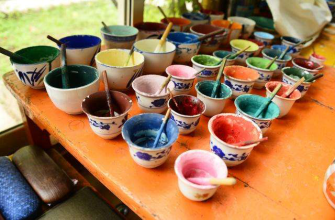
Under a high-powered microscope, a lapis lazuli particle reveals crystalline fragments like shattered sapphires, refracting light from all directions, producing a deep, luminous quality. Synthetic pigments appear as uniform flocs or fog — no crystal structure, only diffuse reflection, looking flat and opaque.
The "millennial fade-resistance" of Regong Thangka is no legend. When lapis lazuli is ground for seven days and nights, when cinnabar red spreads across the canvas — this is not merely painting. It is a dialogue with hundreds of millions of years of geology.